
Rome: The Luxury Guide to the Eternal City
Updated: Jun 19
Rome does not whisper. It announces itself, in marble and fountains and the gold light that falls across two thousand years of history every evening. This is a city where you can sip espresso beside a temple older than most countries, where dinner comes with a view of floodlit domes, and where luxury feels less like indulgence than the natural order of things.
Whether it is your first time or your tenth, this is your guide to the Rome worth lingering in. The hotels that feel like private palazzos, the tables crowned with Michelin stars and rooftop views, and the sights that have stopped travelers in their tracks for centuries. Here is where to stay, where to dine, and how to spend your days.
The Story Behind the Eternal City
Rome calls itself the Eternal City, and it has earned the name. Legend says it was founded in 753 BC by Romulus, who with his twin brother Remus was raised by a she-wolf on the banks of the Tiber. From that myth grew an empire that once ruled the known world, and the layers it left behind are still everywhere underfoot.
A few things worth knowing before you arrive, the kind of detail that makes the city feel deeper once you are standing in it.
It was built on seven hills. The ancient city rose across seven hills above the Tiber, and the phrase has echoed through poetry and politics ever since.
It contains an entire country. Vatican City, the spiritual heart of the Catholic world, is the smallest sovereign state on earth, a nation of barely more than a hundred acres tucked inside the city.
The Pantheon still holds a record. Nearly two thousand years after it was built, its dome remains the largest unreinforced concrete dome in the world, with a single open oculus at its center that lets in the sky, and sometimes the rain.
The coins really add up. Roughly three thousand euros are tossed into the Trevi Fountain on a good day, gathered up and given to charity, all in the name of the old promise that a coin over your shoulder guarantees your return to Rome.
Where to Stay: The Five Hotels Worth Booking
1. Hotel de Russie

Tucked between Piazza del Popolo and the Spanish Steps, Hotel de Russie is the address that artists, writers, and film stars have favored for more than a century, a place the poet Jean Cocteau once called paradise on earth. Its great secret is the Secret Garden, a tiered Mediterranean oasis of orange trees and fountains hidden behind the facade, where you can take aperitivo at the storied Stravinskij Bar. Add the serene Irene Forte Spa and the refined cooking at Le Jardin de Russie, and you have one of the city's most quietly glamorous retreats.
2. Donna Camilla Savelli

For something more intimate and a little more soulful, Donna Camilla Savelli sits across the river in bohemian Trastevere, in a former convent designed in the seventeenth century by the Baroque master Borromini. The curves of his architecture are still everywhere, from the cloistered garden with its citrus trees and fountain to the rooftop terrace with its sweeping view of the skyline. Many of the rooms were once the nuns' cells, now softened into elegant comfort. It is history you can sleep inside, steps from the liveliest streets in Rome.
3. The St. Regis Rome

The St. Regis Rome is grand-hotel living at its most opulent. Opened in 1894 by the legendary César Ritz and recently restored with painstaking care, it dazzles with frescoed ballrooms, a five-meter hand-blown glass chandelier, and a Belle Époque sense of occasion. The signature butler service anticipates your every need, the afternoon tea is a ritual, and each evening the hotel marks the turn from day to night with the theatrical sabering of a champagne bottle. Dinner and cocktails unfold at the luminous Lumen.
4. Hotel De La Ville

The younger, more playful sibling of Hotel de Russie, Hotel De La Ville crowns the very top of the Spanish Steps. Designed around the spirit of the eighteenth-century Grand Tour, it is full of antique globes, maps, and witty contemporary touches. The food, overseen by acclaimed chef Fulvio Pierangelini, runs from the trattoria charm of Da Sistina to the gourmet Mosaico, but the showstopper is the Cielo rooftop, where a sunset spritz comes with a panoramic view across the Eternal City.
5. Rome Cavalieri

Set apart from the crowds on the green hilltop of Monte Mario, within fifteen acres of Mediterranean parkland, the Rome Cavalieri is a world unto itself. Its halls hold a genuine museum-grade art collection, including a Tiepolo and a series of seventeenth-century Flemish tapestries, and its grounds hold sparkling pools and tennis courts with the whole city laid out below. The crown is La Pergola, the rooftop temple of chef Heinz Beck and, since 2005, the only three-Michelin-star restaurant in Rome.
Where to Dine: The Five Tables Worth the Reservation
1. La Terrazza at Hotel Eden
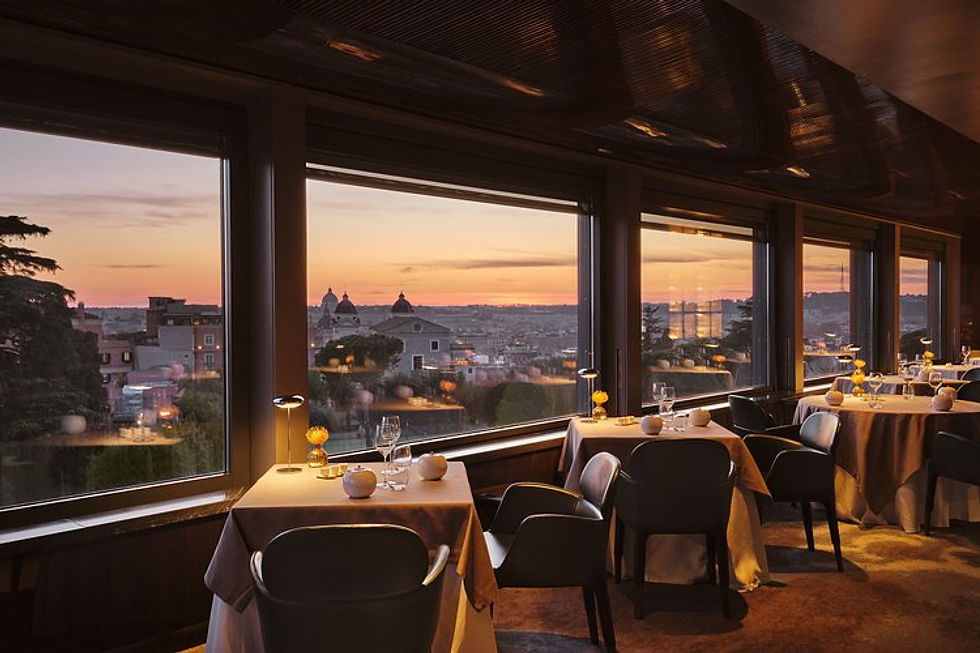
On the top floor of the storied Hotel Eden, La Terrazza pairs one of the most spectacular rooftop views in Rome with a Michelin-starred kitchen led by chef Salvatore Bianco. The cooking is rooted in Mediterranean tradition and lifted with a contemporary, seasonal touch, the kind of refined cuisine that holds its own against a panorama sweeping from the Quirinale to St. Peter's. Come at sunset and let the city turn gold beneath you.

2. Imàgo

Reached by the most beautiful staircase in the world and then a lift to the sixth floor of the Hassler, Imàgo is Rome's original restaurant with a view, and still among its most magical. Through the glass, the bell towers of Trinità dei Monti seem close enough to touch. On the plate, chef Andrea Antonini sends out two tasting menus, one classic and one boldly creative, each a sequence of small, precise, quietly playful dishes. It has held a Michelin star for years, and it earns it.

3. Mirabelle

From the penultimate floor of the Hotel Splendide Royal, near Via Veneto and the gardens of Villa Borghese, Mirabelle frames a view that runs from Villa Medici to St. Peter's and the Janiculum. The mirrored, pale-gold dining room is pure old-world glamour, the service is impeccable, and chef Stefano Marzetti's cooking is classical Italian done beautifully. Save room for the famous Settimo Cielo, the Seventh Heaven dessert, and slip up one floor to the Adèle bar for a nightcap.

4. Le Jardin de Russie

You do not have to leave Hotel de Russie to find one of the loveliest tables in Rome. Le Jardin de Russie spills out into the hotel's enchanting Secret Garden, where you dine among orange trees and soft lighting with the murmur of fountains in the background. The cooking is classic Italian with a Mediterranean lightness, the setting is romance itself, and on a warm Roman evening there are few places you would rather be.

5. Campocori

Hidden inside the Chapter Roma hotel near the old Jewish Ghetto, Campocori is Rome's most seductive dinner-club mood. Designed to evoke a 1930s New York supper club, all dark wood, marble, velvet, and low light, it is theatrical and made for a long evening. Chef Alessandro Pietropaoli reinterprets Italian tradition with a deft, well-traveled hand and the occasional whisper of Asia, from a deeply Roman onion spaghetto to oxtail ravioli and an inventive tasting menu. Stay for a cocktail.

What to Do: The Days Worth Remembering
The Colosseum

You have seen it a thousand times in photographs, and it still stops you cold in person. The Colosseum is the largest amphitheater ever built, a feat of Roman engineering that once held tens of thousands of spectators roaring at gladiatorial games. Go early or book an evening tour, and if you can, add the underground and the arena floor to stand where the spectacle once unfolded.
Vatican City
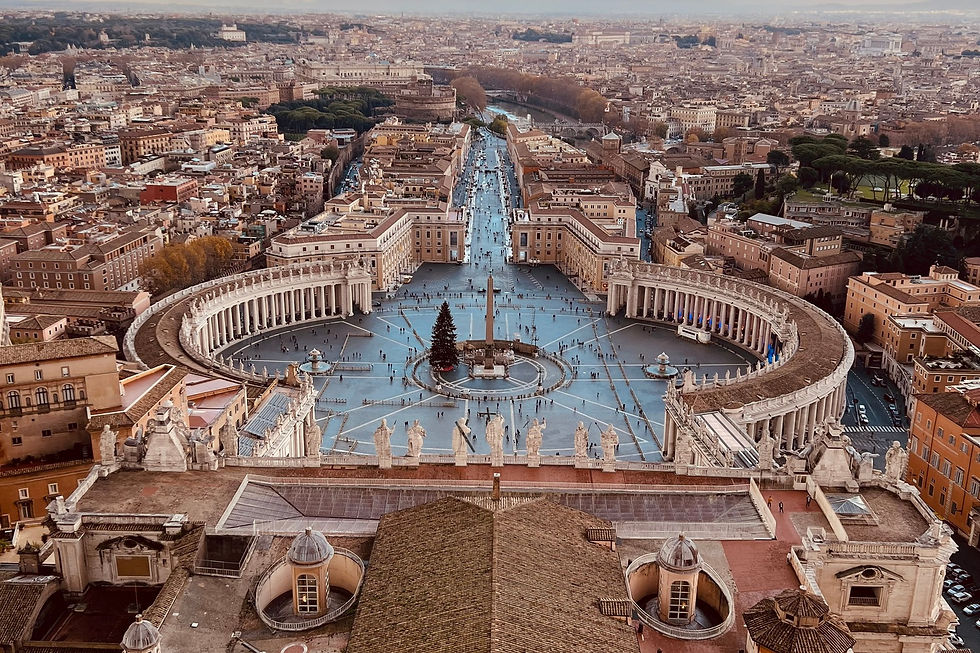
An entire country within the city, Vatican City is unmissable, and not only for the faithful. St. Peter's Basilica is among the largest and most magnificent churches on earth, and the Vatican Museums lead, gallery after gallery, to the ceiling Michelangelo painted in the Sistine Chapel. Book the first entry of the day or a private after-hours tour to feel the scale of it without the crush of the crowds.
Tiramisù at Two Sizes

Rome runs on sweetness, and the city's most beloved tiramisù comes from a tiny shop called Two Sizes on Via del Governo Vecchio, named for the small and large cups it serves. The flavors run through classic, pistachio, caramel, strawberry, and peanut butter, and the queue moves fast. Order the pistachio, carry it a minute up to Piazza Navona, and eat it beside a Bernini fountain. This is Rome at its most joyful.
The Pantheon

Nearly two thousand years old and astonishingly intact, the Pantheon is the best-preserved monument of ancient Rome and still the largest unreinforced concrete dome in the world. Step inside and look up: the oculus, a perfect circle open to the sky, sends a single shaft of light moving slowly across the marble through the day. It remains one of the most quietly overwhelming spaces in the city.
The Trevi Fountain

The grandest fountain in Rome is a Baroque spectacle of sea gods and rushing water, and it has drawn crowds and coins since the eighteenth century. Tradition says that a coin tossed over your left shoulder ensures you will return to Rome, and travelers oblige to the tune of thousands of euros a day, all collected for charity. Come at first light, before the crowds, when the marble glows and you can almost hear the water over the quiet.
The Catacombs

For something hauntingly different, descend into the Catacombs, the vast underground network of early Christian burial tunnels that wind for miles beneath the city, many along the ancient Appian Way. Lit and guided, the galleries of San Callisto, San Sebastiano, and Domitilla reveal faded frescoes and a profound sense of the city's earliest centuries. It is cool, quiet, and unforgettable, a powerful counterpoint to the splendor above ground.
Before You Go
Rome rewards the traveler who slows down. Linger over the long lunch, walk the back streets between the famous squares, toss the coin, look up at the oculus, and let the golden hour catch you somewhere with a view. The Eternal City has been perfecting the art of the good life for nearly three thousand years, and it would love to show you how.
Ready to start planning? Reach out and let us craft the Roman holiday you will be reliving for years.
.png)
Comments